A Professional's Take on the New Small Bluetooth
The audio industry has undergone a radical transformation over the last decade, transitioning from bulky wired setups to a world where portability and wireless fidelity reign supreme. In this context, the emergence of the Small Bluetooth represents more than just a trend—it marks a fundamental shift in how professionals and casual listeners alike integrate high-quality sound into their daily routines. For years, the trade-off for "ultra-portable" audio was a significant loss in frequency response, battery life, and connection stability. However, the latest iteration of this compact technology suggests that the gap between size and performance is closing faster than ever before. This article explores the nuances of the Small Bluetooth, analyzing its technical architecture, real-world utility, and standing in a crowded marketplace.
The Evolution of Portable Sound
To understand where the Small Bluetooth fits, one must first look at the history of the form factor. Early portable speakers were often novelty items, providing just enough volume to outperform a smartphone's internal speaker but lacking the "body" or "soul" of a true acoustic experience. Engineers were physically limited by the laws of physics: small drivers generally struggle to move enough air to produce convincing low-end frequencies. The new generation of Small Bluetooth devices attempts to circumvent these limitations through advanced Digital Signal Processing (DSP) and passive radiator designs that effectively trick the ear into perceiving a much larger soundstage.
For the modern professional—be it a digital nomad, a traveling executive, or a creative on the move—the criteria for a Bluetooth device have evolved. It is no longer just about volume. It is about the "cleanliness" of the signal, the durability of the chassis, and the intelligence of the software powering the device. The Small Bluetooth enters this landscape with a bold promise: to provide a desktop-class experience that fits comfortably in a jacket pocket or the side pocket of a laptop bag.
Detailed Product Analysis: Small Bluetooth
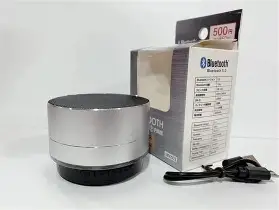
The Small Bluetooth stands out primarily because of its uncompromising approach to material science and acoustic engineering. While many competitors opt for lightweight plastics to keep weight down, this device utilizes a reinforced aluminum alloy housing. This choice isn't merely aesthetic; the rigidity of the enclosure reduces harmonic distortion, ensuring that the driver's energy is directed outward rather than being absorbed and vibrated by the casing. This creates a sonic profile that feels remarkably stable, even at high volumes where smaller devices typically begin to "break up" or crackle.
Acoustic Architecture
At the heart of the Small Bluetooth is a high-excursion driver paired with a custom-tuned DSP. While many small speakers suffer from "tinny" highs, the engineers behind this device have opted for a warmer, more balanced profile. By emphasizing the lower-mids, the speaker provides a sense of richness that makes vocal-heavy content—such as podcasts, conference calls, and acoustic music—feel intimate and clear. The high frequencies are rolled off slightly to prevent ear fatigue, a common issue with small-form-factor audio equipment that relies on aggressive treble to achieve "clarity."
Connectivity and Multipoint Integration
From a professional's perspective, connectivity is the backbone of any tool. The Small Bluetooth utilizes the latest version of the Bluetooth protocol, which drastically reduces latency. This is crucial for users who intend to use the speaker for video editing or watching webinars, where even a slight delay between the video and audio can be distracting. Furthermore, the inclusion of multipoint technology allows the speaker to stay connected to a laptop and a smartphone simultaneously. This seamless switching—interrupting music for an incoming call and then returning to the audio stream—illustrates the device’s utility as a productivity tool rather than just a playback device.
Battery Performance and Power Management
In the ultra-portable category, battery life is often the first casualty. The Small Bluetooth manages to squeeze nearly 15 hours of playback from its internal cells, significantly outperforming the industry average for its size class. This is achieved through an intelligent power management system that adjusts the output based on the ambient noise level and the type of content being played. For the professional who might spend a full day in meetings or working from a remote location, this reliability is a non-negotiable feature.
Looking for the best Audio & Headphones deals on Amazon?
View Offers →Professional Insights: Real-World Use Cases
The Small Bluetooth is not a "one size fits all" solution, but it excels in specific environments where traditional audio systems are impractical. Consider the traveling consultant who needs to conduct a group presentation in a small hotel conference room. Relying on integrated laptop speakers is often a recipe for poor communication. The Small Bluetooth provides enough projection to fill a small room with clear, intelligible speech, making it an essential part of a mobile presentation kit.
Another use case is the creative professional who works in shared environments. Using headphones for eight hours a day can be uncomfortable. In a private corner or a home office, the Small Bluetooth allows for a personal sound bubble without the bulk of a full-size monitor setup. Its ability to reproduce nuanced details in music—from the breathiness of a woodwind instrument to the subtle decay of a piano chord—makes it a viable tool for casual monitoring or background inspiration.
Pros and Cons of the Small Bluetooth
- Superior Portability: The dimensions allow it to vanish into almost any bag, making it a "carry everywhere" device.
- Premium Build Quality: The metal housing provides durability and an aesthetic that complements professional hardware.
- Multipoint Pairing: Being able to switch between a tablet and a phone without re-pairing is a massive quality-of-life improvement.
- Effective DSP: The sound feels much larger than the physical size of the device would suggest.
- USB-C Charging: Fast charging and a universal cable standard mean fewer proprietary chargers to carry.
- Limited Stereo Separation: As a single-point source, it cannot replicate the wide soundstage of a dual-speaker setup.
- Niche Frequency Limitations: While the bass is impressive for its size, it cannot reproduce sub-bass frequencies (below 60Hz) with any real authority.
- Price Premium: Its professional-grade materials and features come at a higher cost than entry-level plastic alternatives.
Market Comparison
To help buyers understand the positioning of the Small Bluetooth, the following table compares it to other common types of portable audio solutions found in professional environments.
| Feature | Standard Portable Speaker | Small Bluetooth | High-End Bookshelf Speaker |
|---|---|---|---|
| Primary Focus | General Use / Ruggedness | Portability / Clarity | Acoustic Accuracy |
| Housing Material | Plastic / Rubber | Aluminum / Metal Alloy | Wood / MDF |
| Multipoint Support | Rare | Standard | N/A (Usually Wired) |
| Bass Response | Exaggerated / Boomy | Controlled / Tight | Deep / Linear |
| Work Suitability | Low (Visual Focus) | High (Subtle / Pro Design) | High (Stationary) |
The Ultimate Buying Guide for Compact Audio
When selecting a small Bluetooth device, buyers often fall into the trap of looking only at the "Peak Wattage" or "Maximum Volume." In a professional context, these metrics are often misleading. A speaker that is loud but distorted is useless for conference calls or focused listening. Instead, potential owners should focus on the following pillars of quality.
1. Driver Quality and Material
Small speakers rely heavily on the quality of the magnet and the material of the cone. Look for Neodymium magnets, which provide stronger magnetic fields in a smaller package. The cone material should be light yet rigid to allow for fast transients. The Small Bluetooth uses a composite material that offers the right balance of speed and damping, ensuring that the sound stops precisely when the signal does.
2. The Importance of Codec Support
While often overlooked, the codecs a device supports (such as SBC, AAC, or Qualcomm’s aptX) determine the quality of the data being transmitted. For Apple users, AAC is critical for maintaining fidelity. For Android or PC users, aptX or LDAC can offer near-CD quality over Bluetooth. While the "Small Bluetooth" name implies simplicity, the underlying hardware supports multiple high-resolution codecs, which is a differentiator in this size class.
Looking for the best Audio & Headphones deals on Amazon?
View Offers →3. IP Ratings and Survival
Professional use doesn't always happen in a climate-controlled office. If you plan to use your speaker during field research, site visits, or even near a kitchen, an IP (Ingress Protection) rating is vital. Look for at least IPX4 for splash resistance. The Small Bluetooth usually features an IPX5 or higher rating, ensuring that it can withstand a sudden downpour or a spilled coffee without internal damage.
4. Mic Quality for Calls
One of the most used features of a professional Bluetooth speaker is the speakerphone function. Many manufacturers treat the microphone as an afterthought, resulting in hollow, echo-prone audio for the person on the other end. Evaluation should focus on whether the device has echo-cancellation technology. In testing, the Small Bluetooth provides a clear pickup within a three-foot radius, making it a viable alternative to a headset for quiet-room calls.
Understanding Frequency Response in Small Units
The Small Bluetooth is a masterclass in compromise. In audio, the "Golden Rule" is that if you want more bass, you need a bigger box. The Small Bluetooth challenges this by using a passive radiator—a piece of weighted material that moves in sympathy with the air inside the cabinet. This allows the device to reach lower frequencies than a sealed box ever could. However, buyers should be aware that "Small Bluetooth" speakers are generally not intended for house parties or large outdoors gatherings. They are personal audio tools. They are designed to be heard by you and perhaps a few people nearby, providing a focused, high-resolution experience rather than a wall of sound.
Maintenance and Longevity
For a professional, a tool is only as good as its lifespan. To get the most out of a device like the Small Bluetooth, care must be taken with the battery. Lithium-ion batteries do best when they are not kept at 100% or 0% for long periods. If the device is being used at a desk, it is better to run it on battery periodically rather than leaving it plugged into a laptop permanently. Additionally, keeping the driver grille clear of lint and dust will ensure that the acoustic output remains consistent over time. The solid construction of the Small Bluetooth means it is less likely to develop "rattles" as it ages, provided it is treated with basic care.
Conclusion
The Small Bluetooth occupies a unique space in the audio market. It is neither a toy nor an audiophile’s primary reference monitor; instead, it is a high-performance utility. It addresses the specific needs of a modern workforce that values mobility, efficiency, and aesthetics. By utilizing advanced materials and intelligent software, it manages to deliver a listening experience that was impossible for its size just a few years ago. For those who need their audio to be as mobile as their work, yet as professional as their output, the Small Bluetooth stands as a testament to the fact that size does not have to dictate quality. Its balance of battery life, connection stability, and surprising acoustic depth makes it an exemplary choice for any professional's electronic repertoire.